











Second in a series of stories about Missy Wood’s early days in Lake Havasu City
By Becky Maxedon
When Missy Wood relocated from her small town in Illinois to Lake Havasu City with her family, she began to settle into her new life and changes to come.
“Settling into life in Havasu was an adventure,” Wood said.
“I realized I was going to have to get a job – but where? There were hardly any businesses, and I wasn’t sure where to start.’
Wood decided to visit some of the limited options she had.
“Finally, I made the bold attempt to try Valley National Bank just up from Claypool’s. It had quite a few customers in the lobby, so I went up to the counter and asked for the manager. I then met Lawson Cocke.”
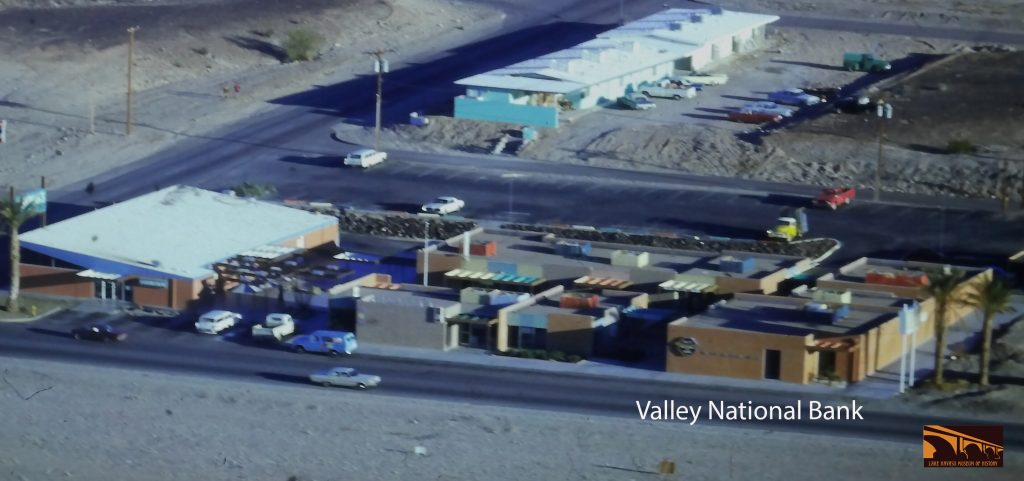
Valley National Bank, far right, in 1968. Claypools is far left in photo. Photo courtesy Lake Havasu Museum of History
She said Cocke looked at her for a moment and asked her if she could take dictation.
“I assured him I could and he asked me to follow him into his office. He handed me a notepad and told me that part of the bank’s job was to answer letters that the bank received and said there were quite a few. So, he proceeds to start dictating a letter.”
Wood froze. “This being my very first job interview, I looked at him and he proceeded with Dear Sir.
“I froze and when he was all done, he asked me to read it back to him. I quaveringly said, ‘Dear Sir’ and stopped.”
Wood said he sat back in his chair and asked her if she could really take dictation, to which she replied, “Yes, this is my absolute first interview and I’m so sorry, I just froze up.”
She said he looked at her a bit longer and then said, “Okay, you are hired.”
The job was originally described to Wood as part-time. She would be working Monday, Wednesday and Friday, but for the first two weeks, she would be full-time to train.
In addition to taking dictation, she would be opening new accounts for new and existing customers. She started the Monday after her interview and never worked part-time the rest of her career at the bank.
“I opened approximately 25 accounts a day and back then, nothing was automated, so everything was done by hand.
“As to the dictation, Lawson dictated no less than 600 letters a month. He said we were like the Chamber of Commerce, Marketing for McCulloch, and any other business in town.”
The bank was busy and the stress level was pretty high, Wood said.
She said that people who purchased lots wanted to know about Lake Havasu City and Cocke was the “go-to” person.
He requested from the home office to hire more help in the lending department and he finally hired Larry Manross, who was also the Presbyterian minister for that church in Havasu.
Wood noticed in the early days there were very few girls her age in Lake Havasu.
“My mom and dad decided we should go to the State Beach when they had Illinois Day. Boy, did I scour the event, and I did find one other person my age – Donna Douglas. We became friends for life.”
Wood’s family was Catholic and ironically, the Sunday Mass was held at the old Mess Hall. “This was definitely a multipurpose building and was right down by the water and boat ramp.”
The building was originally the R & R building for soldiers and had been there a long time. Also there were apartments that were built in an area next to the Site Six boat ramp by Lake Havasu’s founder Robert P. McCulloch.
“He had the end one and C V Woods had the one right next door.”
In 1942, the U. S. military built the Havasu Auxiliary Airfield No. 6 to serve as an emergency landing strip as part of its defense plan. Later it was used by the Air Force as an R & R location with fishing, swimming, boating, skeet shooting and hiking. After the war, the property was purchased by private citizens and was still frequented by military personnel. Ultimately, the property was purchased by McCulloch.
Wood’s life was about to change.
“While at my VNB job, I met Butch (my future husband). He worked for MPI, (McCulloch Properties Inc.) and consistently would come into the bank to get a pay advance.
“I remember Lawson coming up to my counter desk after he had gone and telling me what a nice young man he was.
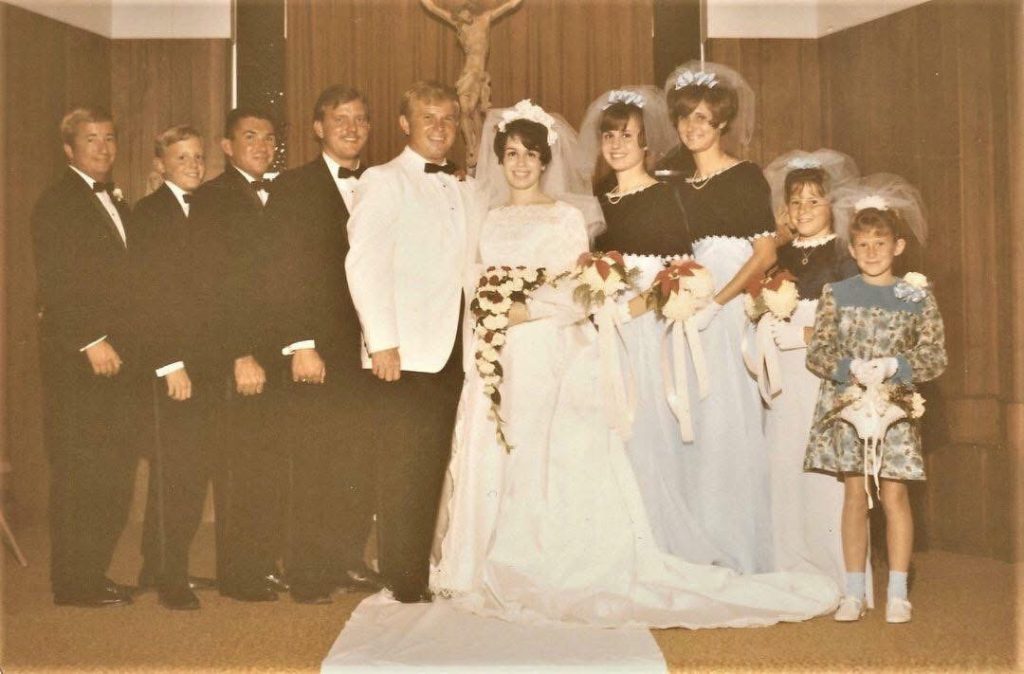
Missy and Butch Wood on their wedding day. Photo courtesy Wood Family
“I told him he sure wasn’t for me as he couldn’t live from paycheck to paycheck. We married a year later in 1969.”
While at VNB, Wood was the person that received the checks from Phoenix and had to sort them for the tellers and backshop to file into the drawers for each account holder.
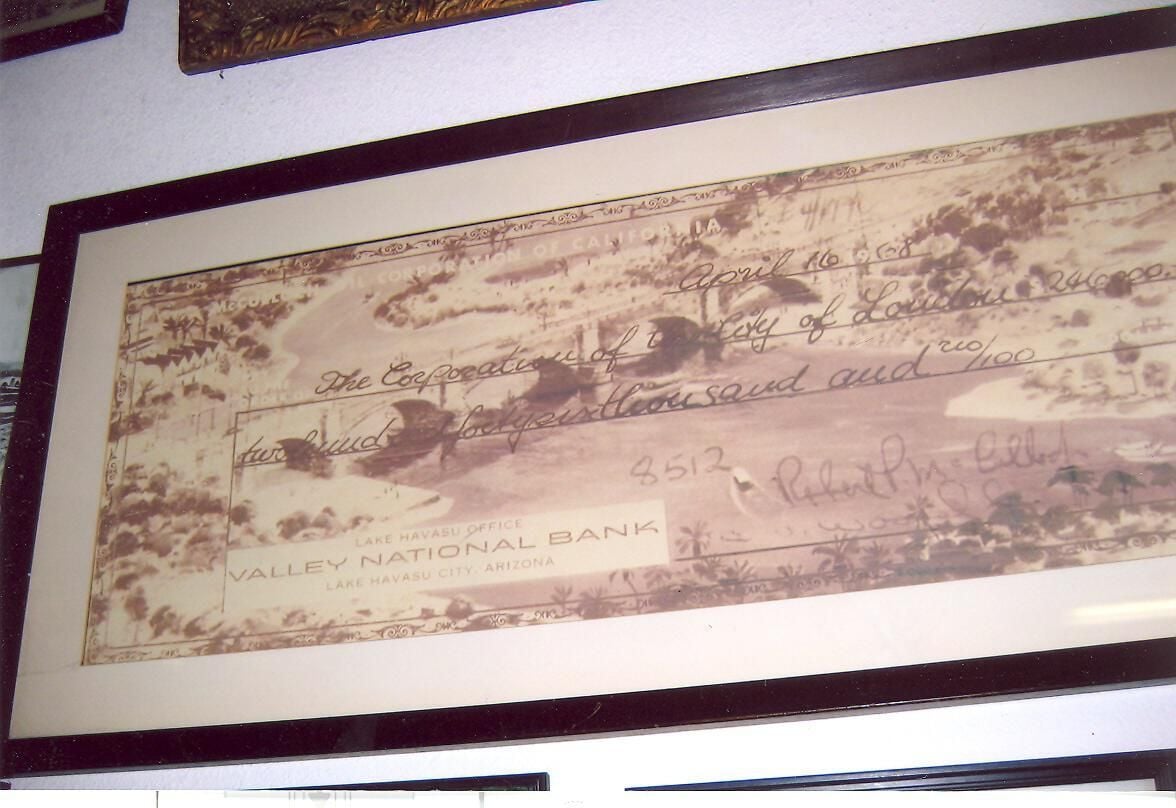
“One day in the stack of checks, I find this really long check like nothing I had seen. It was longer than a regular business check and the design had the bridge on it. As I looked at it, I realized it was the check that had been used to purchase the London Bridge.
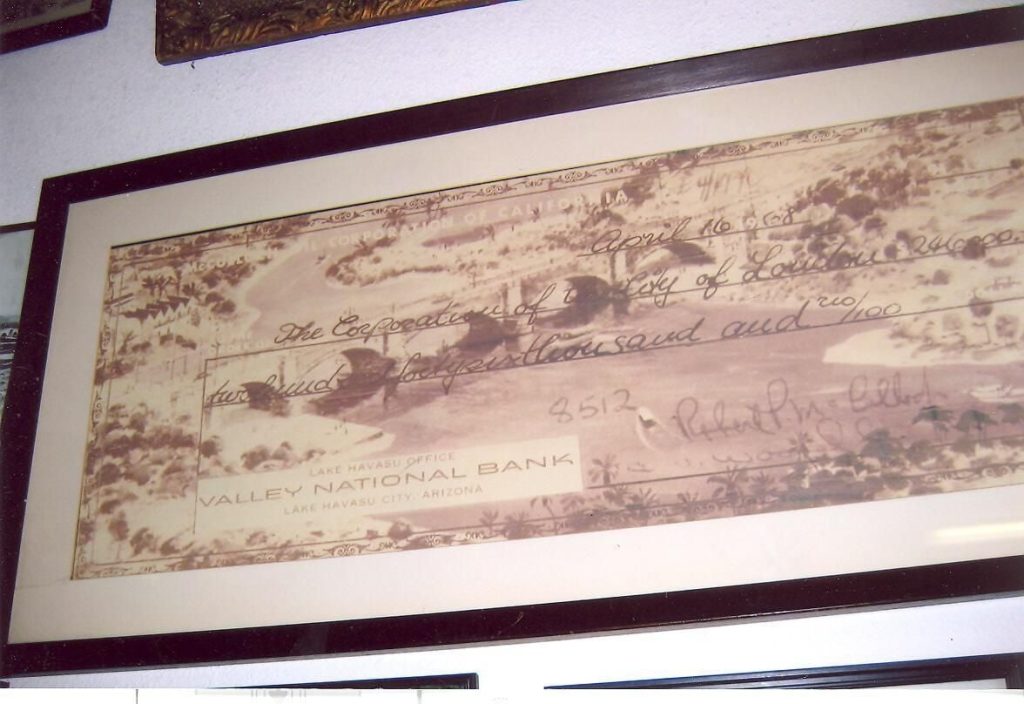
A copy of the check that paid the first installment for the London Bridge purchase for $246,000. The copy of the check now hangs on a wall in the Lake Havasu Museum of History. Photo courtesy Lake Havasu Museum of History
“I got so excited and ran over to Lawson’s desk to show him and Larry and all of the tellers. It was quite a moment for sure,” she said.
The bank got the check back and framed it and placed it over the door when the new facility was built where Chase Bank is now.
“Well, the stress level didn’t go down around the bank and accounts kept growing along with all the loans and letters.
“One morning I got to the bank early and Harry Noye was there, and he said, ‘Missy, you need to sit down, and I need to tell you something.’”
Noye proceeded to tell Wood that Cocke had taken his life.
“I was devastated and after he left, I walked around our desks and on each he had left a note on a stack of work telling us what still needed to be done.”
Duke Doering replaced Lawson as the new manager.
“Later we moved to the new building, and a plaque resides outside in tribute to Lawson.”
Wood left the bank when her daughter was born and took time off before returning to work.
Wood’s story will continue in a future installment in RiverScene Magazine.
To read Missy Wood’s first story, click HERE.


No Comments » Comments: